Enhanced Weathering
EW
Finely ground “climate rocks” such as olivine and basalt are spread on land, where they react with CO2 and water and lock carbon away permanently as carbonates.
How it works
by David E. Comings, M.D.
A well-illustrated, evidence-based account of why climate change and global warming are real and getting progressively worse — and four powerful approaches to removing carbon dioxide from the atmosphere and oceans.
Climate change is no longer a distant possibility — it is one of the most significant challenges facing our world today. In The Science of Global Warming: And Four Ways to Fix It, Dr. David Edward Comings presents a clear, evidence-based explanation of the science behind global warming while offering practical solutions that can help address the problem before its consequences become even more severe.
Written in an accessible format, the book examines the scientific evidence supporting climate change, explores the growing impact of rising carbon dioxide levels, and outlines four powerful approaches for reducing global warming. Readers will discover how individuals, communities, policymakers and even fossil fuel companies can play a meaningful role in removing CO2 from the atmosphere.
One innovative approach suggests a way in which fossil fuel companies can profitably participate in the solution, and a method by which individual citizens can help remove CO2 from the atmosphere. Whether you are a student, educator, environmental advocate, policymaker or concerned citizen, this book provides valuable insight into one of the most important issues of our time.
“Climate change and global warming are real, not a hoax, and will be a great danger to our children and grandchildren.”
— from the author's summary of the book
Drawn from the author's own brief summary of the book. Page numbers refer to the printed edition.
Each card separates established science from the author's proposals, so readers can see where evidence ends and new ideas begin.
Finely ground “climate rocks” such as olivine and basalt are spread on land, where they react with CO2 and water and lock carbon away permanently as carbonates.
How it worksAdding alkaline minerals such as CaO, MgO or Mg(OH)₂ to seawater lets the ocean absorb more CO2 and store it as dissolved carbonate — while countering acidification.
How it worksElectrolysis is used together with olivine to speed up ocean alkalinity enhancement and improve its efficiency.
How it worksA hybrid of two electrolysis techniques removes CO2 directly from seawater as carbonates and returns alkalized water to the sea — no mining, no burial.
How it worksUltramafic and mafic rocks — which the author calls climate rocks — naturally combine with CO2 and water to form stable carbonates. Grinding them to around 1 µm increases their surface area enormously, speeding a reaction that takes thousands of years in nature to as little as several weeks. The mineralized carbon is stored safely above ground.
Silicate weathering is a natural part of the carbon cycle: 99.94% of the Earth's carbon is stored in mineral form, and this chemistry helped keep the Earth from becoming an oven like Venus.
Mine, grind (using renewable energy) and spread gigatons of climate rocks on croplands and other land each year — including a drone program through which NGOs and individual citizens could spread rock dust.
Practical implications: Removing 10 Gt of CO2 would require mining at least 10 Gt of rock — more than the roughly 7.9 Gt of coal mined worldwide each year — so the author calls for an international, Manhattan-Project-scale effort. Applied to cropland, EW can improve rather than remove farmland.
Read “How to Combat Global Warming” (PDF)Ocean Alkalinity Enhancement raises the alkalinity of seawater so that the ocean can take up more carbon dioxide from the air and hold it in stable dissolved form. Early proposals used ground olivine; the author notes that computer modeling suggests CaO, MgO and Mg(OH)₂ are more effective and safe. CaO and MgO can be obtained from mine tailings, and Mg(OH)₂ can be generated in large quantities from olivine.
The oceans already hold about 50 times as much CO2 as the atmosphere, and ocean acidification, warming and deoxygenation are documented threats to marine life and the billions of people who depend on the sea.
Deploy OAE at gigaton scale as a safe, permanent alternative to burying CO2 gas — one that also helps combat ocean acidification and the loss of coral reefs.
Practical implications: Like EW, OAE depends on large-scale mining and processing of minerals, and its storage is in the ocean rather than underground.
Read the Addendum (PDF)Electrolysis-assisted OAE combines olivine with electrolysis to accelerate the process and make it more efficient. The author proposes that eOAE units could be installed on ships, bringing the treatment to the ocean.
Electrochemical methods for changing seawater chemistry are an active area of research in carbon-dioxide removal.
Mount eOAE units on ships powered by renewable energy — potentially crewed and operated by NGOs and non-profits on inexpensive catamarans.
Practical implications: Requires both olivine supply and substantial electrical energy, which the author suggests could come from solar, wind and potentially modular nuclear or molten salt reactors.
Read the Addendum (PDF)eOAE2 — or simply e2 — combines one electrolysis process that removes CO2 from seawater and converts it to mineral carbonates (La Plante et al., 2021, 2023) with a second that produces an alkali such as NaOH to alkalinize the seawater returned to the ocean, so it can absorb more CO2. Both reactions produce hydrogen, which can be used in fuel cells to offset part of the electricity needed.
The electrochemical removal of CO2 from seawater as carbonates has been demonstrated in published research (La Plante et al., 2021, 2023).
Power e2 on ships or barges docked at floating solar and wind-turbine islands placed in ocean currents — and potentially retrofit nuclear-powered naval vessels — to sequester gigatons of CO2 at low ongoing cost.
Practical implications: The author describes e2 as an ideal approach because it requires no burial of CO2 gas, no mining of climate rocks and no foreign substances added to the ocean — but it needs large amounts of electricity.
Read the Addendum (PDF)Why not simply bury the CO2? Direct Air Capture with underground Sequestration (DACS) is currently the most widely funded approach. The foundation's report argues that at gigaton scale it carries high energy costs and the risk of deadly leaks, and that safe, permanent alternatives storing carbon in mineral form above ground or in the ocean are needed alongside it. Read the Addendum (PDF)
The aims of the book, as printed on its back cover.

“So many new things relevant to this book kept coming up” that Dr. Comings publishes seasonal reports covering new research and events since publication. Free to download.

Dr. Comings explores the scientific principles behind climate change, the evidence for global warming, and the four approaches he presents for addressing it.
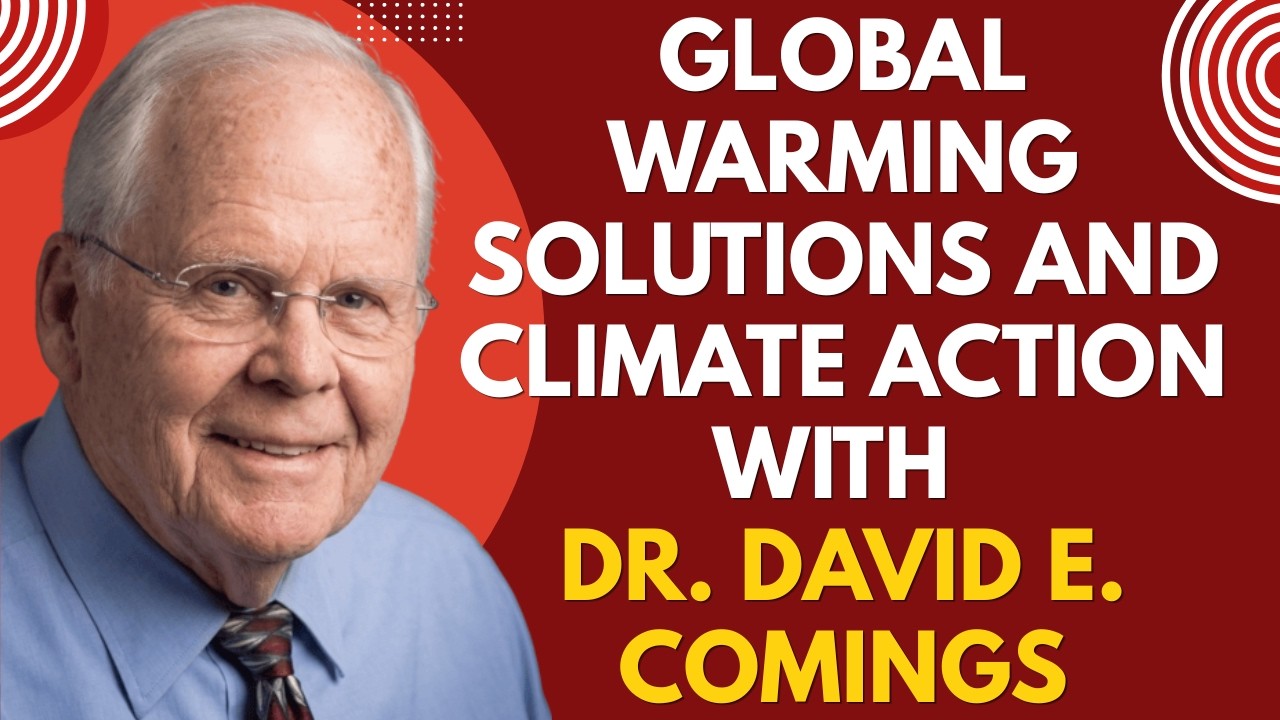
Episode 1618 of the Robert Plank Show: moving past fear, politics and denial to practical, science-based climate solutions.

A conversation with Dr. Comings about The Science of Global Warming and what can be done to reverse it.
The peer-reviewed papers and reports behind the book's arguments.
Argues that even if no single climate tipping point has been fully activated, the additive effect of many partially activated tipping points has begun and could lead to an irreversible positive feedback loop — and that the way out is to activate multiple Negative Emission Technologies globally.
Brings to public attention scientific observations rarely highlighted in climate discussions: a CO2 feedback loop, driven by ocean warming, that the author argues will keep atmospheric CO2 rising even after net-zero emissions.
A science-based, 390-page assessment of six Negative Emission Technologies able to work at the many-hundred-gigaton level — DACS, in-situ mineralization, Enhanced Weathering, OAE, eOAE and eOAE2 — and the case for adding the last four to direct air capture.
Available now in paperback, Kindle and audiobook editions.