Over 5 trillion pieces of plastic currently litter the ocean.
1. The Ocean Cleanup Foundation
There are a number of very worthy foundations that are addressing the problem of plastic in the ocean. Many of them work to clean up beaches and harbors and reduce the amount of plastic entering the ocean. However, we felt that there was a need to address the problem directly - i.e. remove the plastic that is now in the ocean. We felt that The Ocean Cleanup Foundation https://www.theoceancleanup.com was addressing this directly.
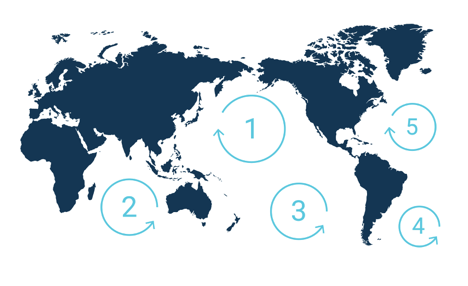
This trash accumulates in five ocean garbage patches, the largest one being the Great Pacific Garbage Patch (1), located between Hawaii and California is about the size of Texas. If left to circulate, the plastic will impact our ecosystems, health and economies. Solving it requires a combination of closing the source, and cleaning up what has already accumulated in the ocean.
The Ocean garbage patches are vast and dispersed. Ocean currents concentrate plastic in five areas in the world: the subtropical gyres, also known as the world’s "ocean garbage patches".
Once in these patches, the plastic will not go away by itself. The challenge of cleaning up the gyres is the plastic pollution spreads across millions of square kilometers and travels in all directions. Covering this area using vessels and nets would take thousands of years and cost billions of dollars to complete. How can we use these ocean currents to our advantage?
Research shows the majority of plastic by mass is currently in the larger debris. By removing the plastic while most of it is still large, we prevent it from breaking down into dangerous microplastics. Our passive systems are estimated to remove half the Great Pacific Garbage patch in just five years, and at a fraction of that cost. This is how it works:
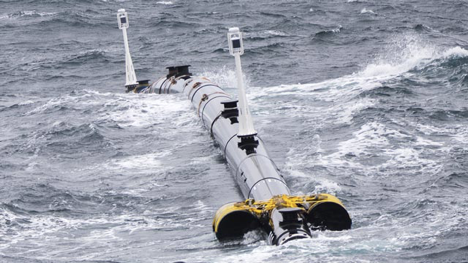
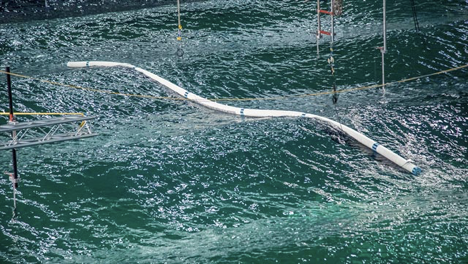
Create coastlines where there are none. The system consists of a 600-meter-long floater that sits at the surface of the water and a tapered 3-meter-deep skirt attached below. The floater provides buoyancy to the system and prevents plastic from flowing over it, while the skirt stops debris from escaping underneath.
Take advantage of natural oceanic forces. Both the plastic and system are being carried by the current. However, wind and waves propel only the system, as the floater sits just above the water surface, while the plastic is primarily just beneath it. The system thus moves faster than the plastic, allowing the plastic to be captured.
Expected Impact Our floating systems are designed to capture plastics ranging from small pieces just millimeters in size, up to large debris, including massive discarded fishing nets (ghost nets), which can can be tens of meters wide. Models show that a full-scale cleanup system roll-out (a fleet of approximately 60 systems) could clean 50% of the Great Pacific Garbage Patch in just five years. After fleets of systems are deployed into every ocean gyre, combined with source reduction, The Ocean Cleanup projects to be able to remove 90% of ocean plastic by 2040.
Monitoring and Safety. Each system will be equipped with lanterns, radar reflectors, navigational signals, GPS and anti-collision beacons.
The AIS will continuously broadcast the location of the systems to passing vessels and the GPS will track the location of our systems, should they veer out of the patch. The US Coast Guard will chart the area as a special operations zone and will issue a Notice to Mariners concerning the presence of our systems.
They have also conducted an Environmental Impact Assessment (EIA) through an independent agency, CSA Ocean Sciences, which did not identify any major risks of our method to the environment.
Surviving Storms The system (System 101) has been engineered and tested to utilize and withstand the forces of the ocean. While designing the structure, we considered load cases that are only expected to occur once every hundred years. The key to survivability is flexibility. We designed the system to be limber enough to be able to follow the waves, and because the system is free-floating, it can drift when subjected to high current speeds.
In May 2018, a 120-meter section of the system successfully passed a tow test in the Pacific Ocean, being subjected to waves of up to 5 meters.
Hundreds of scale model tests were conducted throughout the years to refine the design and predict the behavior and performance of the system
Watch the video to understand the technology
https://www.theoceancleanup.com/technology/#top
Or go to YouTube - The Ocean Cleanup Technology, Explained
In May 2018, a 120-meter section of the system successfully passed a tow test in the Pacific Ocean, being subjected to waves of up to 5 meters. However, more recent updates report that this apparatus
a) it was not totally effective in scooping up the plastics, and
b) it broke and had to be towed to Hawaii.
Hopefully these are temporary setbacks that will be solved.
October 2019
The problems with the ocean cleanup technology have been solved. Attention has now been focused on cleaning up the source of the plastic in the oceans - the rivers. Monitoring rivers worldwide has shown that 1000 rivers are contributing 80% of the plastic to the ocean. The ocean cleanup.com has developed a river cleanup machine. For details go to their site (above).
2. 5 Gyres
Our mission is to empower action against the global health crisis of plastic pollution through science, education, and adventure. Our vision is a world free of plastic pollution! We're honored to be members of Break Free From Plastic, an international movement that unites non-profit organizations to fight plastic pollution, sharing the common values of environmental protection and social justice. We are also founding members of the Plastic Pollution Coalition, a global alliance of organizations, businesses, and thought leaders working toward a world free of plastic pollution and its toxic impact on humans, animals, and the environment. In 2017 we received special consultative status with the United Nations Economic and Social Council.
A gyre is a large-scale system of wind-driven surface currents in the ocean. The gyres referred to in the name of our organization are the five main subtropical gyres—located in the North and South Pacific, the North and South Atlantic, and the Indian Ocean—which are massive, circular current systems.
Solutions are found when organizations like 5 Gyres work with people, politicians and corporations to stop emissions at the source. Microbeads are a great example. During a 2012 5 Gyres expedition, we found plastic microbeads—tiny round microplastics used in personal care products—in the Great Lakes in an open-water setting. That research started a movement, which culminated in President Obama signing the Microbead Free Waters Act in 2015. The law will go into effect in 2018.
In 2017, the United Nations announced its #CleanSeas initiative to eliminate single-use plastic bags and microplastics in cosmetics by 2022. With better communication of new science, increased attention to improved waste management, and smarter plastic product design, the problem of plastic debris drifting in the furthest reaches of the planet can be controlled.
One positive is that 5 Gyres is in our backyard allowing us to work closely with them
The 5 Gyres Institute
5792 W Jefferson Blvd,
Los Angeles, CA 90016
3. The Plastic Solutions Fund supports projects aimed at reducing production of single use plastic and packaging, with a focus on key drivers of system change in the plastic supply chain.
Projects:
Eliminating Taiwan’s “Notorious Five”
This proposal is aimed to eliminate (or reduce to a minimum) the top 5 disposable plastic products by 2020, including plastic bags, Styrofoam products, multi-material sachets, plastic utensils and straws, sanitary pads and disposable diapers.
The Story of Plastic
In the Story of Plastic, an 11 episode web series, we'll meet change makers from all over the world who are fighting back against big plastic from the extraction of fossil fuels to make plastic, how plastic waste flows around the world and the citizens it effects, as well as industry's aggressive push open new markets regardless of their ability to digest or manage plastic waste.
Zero Waste Cities
Grantees: GAIA, Mother Earth Foundation, Pecinta Budaya Bebali (YPPB), Thanal, Stree Mukti Sanghatana (SMS), Health Care Without Harm, EcoWaste Coalition, Consumers Association of Penang (CAP), Citizen consumer and civic Action Group (CAG).
Although the Zero Waste Cities project is only in its eighth month, work has started in all areas we had planned on, and these early stage activities have created significant momentum toward our primary objectives.
Turning the Tide on the Plastic Industry’s Political Stronghold
Californians Against Waste Foundation’s (CAWF) project is focused on community outreach and education around single-use take-out food packaging.
ESDO Microbeads
Grantees: Environment and Social Development Organization-ESDO (Funder-BFFP: Plastic Solution Fund and Rockefeller Philanthropy Advisors). With the advancement of time the use of micro plastics in personal and home care products have greatly increased worldwide. We propose to reverse this trend.
4. Oceans 5 includes new and experienced philanthropists with a common inspiration for collaborative, results-oriented grant making. We share a desire to secure tangible improvements in global ocean health, while also strengthening ocean conservation philanthropy.
Oceans 5 makes direct grants, leverages matching grants, provides in-kind services and shares strategic guidance – all to support our grantees. We focus on projects and campaigns to constrain overfishing and to establish marine reserves. We are inspired by projects that are significant and strategic, particularly if they provide tangible and lasting benefits to the world’s oceans. We prefer projects that engage multiple organizations working toward common objectives over discrete periods of time. We welcome the opportunity to work with potential grantees to help develop ideas and strategies.
Oceans 5 is an international funders collaborative comprised of Partners and Members who help identify, assess and approve projects for investment. They also remain engaged in project oversight and implementation. The collaborative is a sponsored project of Rockefeller Philanthropy Advisors, a 501(c)(3) nonprofit organization that manages more than $280 million in charitable giving. RPA provides staff support and financial management services for a small fee.
Projects.
Oceans 5 Supports a wide range of projects - as follows. To see the web pages of the individual projects go to the oceans5.org
web site.
Protecting Canada’s Marine and Coastal Environment
Conservation of the Patagonian Sea
Protecting the Adriatic Sea
Protecting Remote British Overseas Territories
Regulating Deep Sea Mining
Protecting Micronesian Waters
Reforming Fisheries in St. Helena
Global Partnership for Sharks and Rays
Establishing MPAs in Antarctica
Combatting IUU fishing in Japan
Developing Marine Managed Areas in Melanesia
Evaluating Distant Water Fishing Fleets
Transforming Tonga’s Ocean Management
Plastic Solutions Fund
Reducing Unsustainable Shark Trade
Protecting the South Atlantic from IUU fishing and Human Rights Abuses
Creating a Marine Park in the Cook Islands
Constraining Illegal Fishing: Eastern Tropical Pacific
Analyzing Purse Seine Ownership
Protecting Niue
Improving China’s Domestic Fisheries
Protecting the Seychelles
Reef fish conservation
Protecting and financing Cuba’s marine protected areas
Rebuilding Cuban fisheries
Electronic Monitoring for Pacific Tuna
Fishing Vessel Compliance in Indonesia
Improving Transparency in South Korea and Taiwan
Protecting Russia’s Arctic
Transshipment governance in the Western and Central Pacific Ocean
Expanding the Ring of Life for the Russian Marine Arctic
Building Transparency in West Africa
Expanding Pacific Remote Islands Monument
Establishing an MPA Network in South Africa
Controlling Illegal Fishing in Europe
Coordinating Compliance Management in the Central ETP
Improving Traceability Policy Work in Japan
Working to Protect the High Seas
Marine Spatial Planning in the Eastern Caribbean
Protecting the Phoenix Islands
Protecting Canada’s Northwest Passage
Curbing Destructive Fishing in Nicaragua
Advancing Marine Protected Areas in The Bahamas
Supporting the Arctic Council
National Marine Monument Coalition
Northern Bering Sea Protected Area
Improving Fisheries in the Mesoamerican Reef
Protecting Antarctica
Improving Seafood Traceability
Strengthening High Seas Governance
Sources & further reading
- theoceancleanup.com
- Great Pacific Garbage Patch
- theoceancleanup.com/technology/#top
- Rockefeller Philanthropy Advisors
- oceans5.org
Archived from the original page: www.thecomingsfoundation.org/styled-5/styled-16/. Some external links may no longer be active.